Showing posts with label Hostesses. Show all posts

Wednesday, 1 January 2025

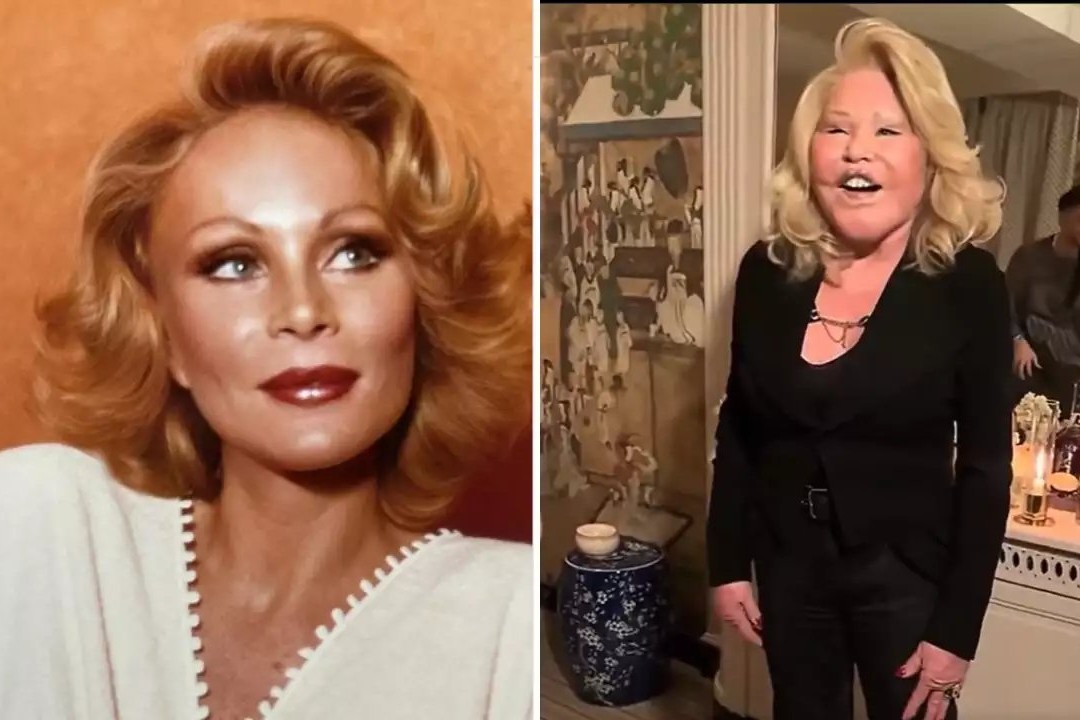
That face

"I love that face, that face, it just isn't fair
You must forgive the way that I stare
But never will these eyes behold a sight that could replace
That face, that face, that face."

In a final flourish of attention-grabbing - surely what her entire tragic, plastic-surgery-enhanced existence was all about - the final entry in 2024's "Book of the Dead" has departed for the "Beauty Salon Reject Area" of Fabulon. RIP, Miss Jocelyn Wildenstein (née Jocelyne Périsset, 5th August 1940 – 31st December 2024)!

Wednesday, 28 February 2024

Princess Tiger Eyes


The higher the hair, the closer to god...

From the Telegraph:

Princess Ira von Fürstenberg, who has died aged 83, was an Italian socialite, B-movie actress and fashion model, whose “profile of Renaissance beauty and fascination, like the portraits of young noblewomen in the Uffizi” was celebrated in 1960s Vogue.

A niece of Gianni Agnelli and the epitome of the jet set, Ira von Fürstenberg had, by the time she was 20, already been married to two of the 20th century’s most notorious playboys, Prince Alfonso von Hohenlohe, the so-called “King of Clubs” who invented the resort of Marbella (and jealously refused Salvador Dalí’s request to paint Ira naked), and the Brazilian industrialist Francesco “Baby” Pignatari.

She was only 15 at the time of her first marriage, and needed special dispensation from the Pope to wed von Hohenlohe, 31, who had proposed to her by telegram after seeing her in a vision as he crawled clear of the wreckage of a plane crash. Ira the child-bride made the cover of Life magazine in 1955, leading a flotilla of 130 gondolas to the church in Venice. Her mother’s family company, Fiat, gave them a red Cinquecento, wrapped up and tied with a bow.

Five years later, by now neglected and disenchanted, she eloped with the 44-year-old Pignatari. Von Hohenlohe sent armed policemen to catch the couple in flagrante in a hotel in Mexico City, and there was a fight. Then von Hohenlohe kidnapped their two sons, and went on the run for two and a half years, occasionally dressing the boys in wigs and dirndls to pass them off as girls, to evade the princess’s million-dollar reward offered to anyone who could find them.

Her 1961 marriage to Pignatari in Reno ended in divorce in Las Vegas in 1964, after he sent a friend to tell her: “Baby wants to leave you.” As her son Hubertus later put it: “She had got caught up in a man’s world as half a child.” She steered clear of matrimony thereafter, although in the 1980s she seemed close to becoming the second wife of her cousin, Prince Rainier of Monaco, after the death of Grace Kelly.

The Agnelli money permitted her to lead a life of peripatetic glamour, with houses in Mayfair, Madrid, on the shores of Lake Geneva, on the Via Veneto in Rome, where she had avant-garde perspex furniture, and in the Place Vendôme in Paris, where she had solid gold bath taps. (“Everybody has to see something beautiful in the morning in order to have a good day,” she said.) She told her biographer, Nick Foulkes, however, that “my only real home is on aeroplanes. I spend so much time going from country to country that my children suspect that I’m really a flight attendant.”

It was on a plane in 1966 that she met the producer Dino De Laurentiis, who saw star potential in her famous tawny eyes (“princess tiger eyes”, her first husband called her). Her film debut was the James Bond spoof Matchless (1968), co-starring Patrick O’Neal and Donald Pleasence, and she went on to grace the screen in a string of “sex kitten” roles, playing opposite Anthony Quinn, Peter Lawford, Klaus Kinski and Walter Chiari; she was even screen-tested by Roger Vadim for the lead in Barbarella.

She declined to star in one of Tinto Brass’s erotic movies, but as a rule, over her 29 film and television roles, she was content to wear very little, reassuring her anxious father that “for the moment my acting does not have the same power to make people flock to the cinema as my body”...

When the parts dried up, Princess Ira merely moved on - running the fashion house Valentino’s perfume division, and using her influence in the world of haute couture to bolster the career of her protégé Karl Lagerfeld. In later life she became a renowned artist and sculptor, whose works sold for thousands to the latter-day "jet-set".

What a woman! What a life!

RIP, Princess Ira von Fürstenberg (17th April 1940 - 18th February 2024)

Monday, 19 December 2022

REAL Royalty


[click to enlarge]

HRH Princess Margaret and her "courtiers" on the island of Mustique.

Sunday, 1 May 2022

Closing time at the club

Very sad news. The doyenne of the nightclub scene, gay icon, "Queen of the Night", inventor of the term "discothèque", one of our Patron Saints - the legendary Régine has traversed the velvet rope and the glitter curtain and departed for Fabulon.

One of those "famous Belgians", she rose from hat-check girl at Paris' famous Whisky à Gogo club in the 1950s, to club hostess, to "disc jockey" (although that term didn't exist at the time), to running her own nightclub empire. At its height in the 1970s, she had Chez Régine clubs in 23 locations across the globe, from Kuala Lumpur to Rio, including top-drawer venues in New York, Paris and London, and attracted all the best names; from royalty to Hollywood to musical divas.

I have featured her many, many times over the years; here and over at my regular blog Give'em the old Razzle Dazzle, but on this sombre occasion I make no excuses for repeating some of her fantabulosa numbers:


She left us with one of the wisest mottos for life: "If you can't dance, you can't make love."

RIP, Régine Zylberberg (born Regina Zylberberg, 26th December 1929 – 1st May 2022)

Sunday, 5 July 2020

The swan nonpareil


From The Robb Report:
Every artist must settle on a medium; and although Truman Capote, as a boy, imagined a career in films, by the time he turned 20 he had tied his hopes to a literary career. Style - in language and in life - was a preoccupation for the author of Breakfast at Tiffany’s and In Cold Blood, whose aesthetic ideal was the fusion of ambition and taste in what he described as a living work of art. “There are certain women,” he said, “who...are born to be rich. By and large, these persons are artists of an odd variety; money, in astronomical amounts, is their instrument.”

Capote became an eminent connoisseur of such venal virtuosos, whom he playfully called his “swans.” These ladies shared more than friendship with the writer: each possessed striking looks, a flawless fashion sense, and a determination to secure the means to bend the world to her whims. “He...got the sense of what a person wanted to be,” recalled one acquaintance, “and then he helped her to achieve it. It was his way of getting close to her.”

...The swan nonpareil, however, was Barbara “Babe” Paley. “Mrs. P. had only one fault: she was perfect,” Capote noted. The youngest of the three celebrated Cushing sisters of Boston, Paley abandoned her post as an editor at Vogue for the more remunerative position of Mrs. Stanley Mortimer. She filed for divorce when the Standard Oil heir returned from service in World War II a broken man, and thanks to the ministrations of her well-connected sister Betsey Whitney, she displaced the first Mrs. William S. Paley to become the second wife of the broadcasting pioneer.

Capote met Paley in 1955, when one of her guests asked if “Truman” could join them for a weekend on her estate in Jamaica. Expecting the former president of the United States, she agreed. From the moment the impish author boarded the private plane, he and Paley were inseparable.
Barbara "Babe" Cushing Mortimer Paley (5th July 1915 – 6th July 1978)

Friday, 22 September 2017

Someone really should make this story into an opera


With all its intrigues, unlikely relationships, financial and political shenanigans, deception, bitter revenge and wronged families, one could hardly imagine a more complicated, scheming, scandalous and decadent plot appearing in any of the masterworks of Puccini, Mozart, Donizetti, Giordano or Verdi.

I have long been fascinated by the saga of the "world's richest woman" in her dotage, her unlikely (gay) suitor upon whom she bestowed billions, her bitter and wronged daughter, the Machiavellian "advisors", the whiff of political scandal that threatened to bring down the French government, the sinister attorney, and the ingenious butler who exposed it all...

The Daily Beast:
The French have a colourful term - s’encanailler - which roughly means slumming, hanging out with rakish types from a different social milieu. That was undoubtedly part of the magnetism that drew [billionaire L'Oreal heiress Liliane Bettencourt] to [little-known gay photographer] François-Marie Banier...

“Liliane was rich, she was beautiful, and she was bored to death,” said her former lawyer Georges Kiejman... [but] "when Banier arrived on the scene, he immediately put some spice into her life."

Brash, provocative, iconoclastic, he had none of the kowtowing deference that she was accustomed to. He would criticize her clothes, her hairstyle, playfully call her names at times, even as he flattered her and praised her beauty, her intellect, her sensitivity. Banier also talked to her about books and philosophy and art, things that were not part of [her late husband] André’s dinnertime conversation. And he brought her out of her shell, introducing her to artists, writers, and actors, escorting her to art galleries, museums, theatres, auction houses. As Liliane put it, “he renovated me.”...
From National Public Radio (NPR):
Emotionally and fiscally, their interests dovetailed: Banier opened up the stimulating art world to Bettencourt by escorting her to galleries, introducing her to his bohemian friends, reading aloud to her from Stendhal's Charterhouse, and being thrillingly irreverent in denouncing the giant Monet in her mansion as "hideous." Entranced, she lavished him with money and gifts, including paintings by Picasso and Matisse, apartments, and millions in life-insurance policies. For 25 years, Bettencourt played the generous Galatea to Banier's Pygmalion, with the total of her largesse teetering to an incredible one billion euros.

In 2007, Bettencourt's only child, her daughter Françoise Bettencourt Meyers, filed a criminal suit against Banier for abus de faiblesse (abuse of weakness), claiming that this "Rasputin" had ruthlessly exploited her then 84-year-old mother's oncoming dementia. Meyers, a quiet woman described by a friend as "an austere Carmelite nun," says her hand was forced when an eavesdropping chambermaid told her she had heard Banier asking to be adopted by Bettencourt.

The scandal, which electrified France for a decade, came to be known as the Bettencourt Affair.
From Mediapart:
[Pascal Bonnefoy, the long-serving butler to Mme Bettencourt] produced damning testimony against François-Marie Banier, who he said "destroyed" the Bettencourt family, humiliated Liliane by calling her "a bitch", and whose "arrogant" behaviour included urinating over plants at the Bettencourt home.

He also launched a scathing attack on Patrice de Maistre, the billionaire's wealth manager, and others in her close entourage who he said "hide behind a tired and fragile woman" while leading her astray.

"I could not accept the unacceptable, and for me it was like the scene of a car accident and not stopping to help," he said in his statement to police detectives. "I could not continue without doing anything and still be able to look at myself in the mirror. I had served Monsieur and Madame Bettencourt during so many years, and I could not let all these people around Madame carry on without reacting."...

...The transcripts of the tapes, which were handed by Bonnefoy to Liliane's daughter Françoise and then to police, principally concerned conversations between Liliane Bettencourt and her wealth manager, her tax lawyer and solicitor, and François-Marie Banier. They were made between May 2009 and May 2010, recorded on a digital Dictaphone placed behind a chair in Bettencourt's private office in her town mansion home in Neuilly-sur-Seine, just west of Paris.

Bonnefoy said he was prompted into making the recordings after he was subject to a campaign of ostracism led by Banier...
From The Guardian obituary today:
The saga resulted in not only a public family feud but a major political scandal and courtroom drama when the investigation was extended to look at whether Sarkozy and other figures in his party had also taken advantage of the elderly Bettencourt, asking for money from her after it was declared that she had dementia.

The money, alleged to have been given in brown envelopes, was said to have funded Sarkozy’s 2007 presidential campaign.

The “Bettencourt affair” tarnished the latter half of Sarkozy’s presidency, and when he lost the 2012 election he was placed under formal investigation for illegal campaign financing and taking advantage of Bettencourt. But the charges against Sarkozy were dropped in October 2013 due to lack of evidence.

In 2015, the photographer Banier was convicted of exploiting Bettencourt and sentenced to three years in jail, fined €350,000 and ordered to pay €158m in damages. He appealed and last year received a suspended prison sentence and a fine but did not have to pay the vast damages.
..and The Guardian, again, from 2010:
[Georges Kiejman, speaking in court, commented:] "This is a family story; the daughter is trying to use this court to settle a psychological conflict with her mother. It's a 57-year-old little girl complaining 'my mummy doesn't love me. She loves him more than me'."

Kiejman added: "That Madame Bettencourt should have the misfortune of finding the brilliant Mr Banier more amusing that her own daughter – and between you and me that's no surprise – is not for this court to decide."
The court certainly did decide. Banier was shamed, but kept his fortune. Sarkozy survived, albeit with his reputation tarnished. Liliane was to remain in the care of her daughter, and the L'Oreal fortune was secured. No idea what happened to the butler.

I await the first production of this Machiavellian operatic masterpiece, opening at a concert hall near you...

RIP Liliane Henriette Charlotte Bettencourt (née Schueller, 21st October 1922 – 21st September 2017)

Friday, 21 August 2015

Rantum-scantum - the Scandalous Lady W


From a review of the book Lady Worsley’s Whim by Hallie Rubenhold in The Spectator back in 2008:
There is a magnificent portrait by Reynolds at Harewood House in Yorkshire of Lady Worsley. She wears a sweeping red riding habit, she looks self-assured and alert, and she holds a riding crop as an allusion to her skill as a horsewoman. In reality... [she] was one of the most scandalous women of her day, the subject of the first squalid celebrity divorce.

Lady Worsley, who rejoiced in the odd first name of Seymour, was a massive heiress. She inherited a fortune of over £60 million in today’s money from her father, Sir John Fleming, who owned a farm in the London suburb of Brompton. Aged 18, she married a wealthy, socially ambitious baronet named Sir Richard Worsley. He set about advancing and advertising himself in the fashion of the day. He became a MP and made lavish improvements to his house, Appuldurcombe on the Isle of Wight.
However, their marriage was passionless, and the headstrong and wayward Seymour embarked upon an affair with the Worsleys' neighbour, Maurice George Bisset.
Seymour became pregnant by Bisset, but Sir Richard, far from stopping the relationship, seemed determined to encourage it. He invited Bisset to share a house with him and his wife when he went on manoeuvres with the militia at Maidstone and then Lewes.

One night Seymour and Bisset decided to elope. This... was an extraordinarily foolhardy thing to do. Seymour stood to lose not only her fortune, but also her reputation, her children and - what she minded more than anything - her clothes and jewels worth a staggering £15 million. The lovers dashed to London and went into hiding in a hotel. Seymour stayed in bed for days, but this was only partly due to passion: she had left all her clothes behind and her mean-minded husband refused to send any. Humiliated and dishonoured, Sir Richard plotted his revenge. He planned to ruin Bisset financially and shackle his wife to him for life. He sued Bisset for crim con or "criminal conversation" - in other words adultery - and claimed damages of £20,000 (£25 million today).

In a superb moment of courtroom drama, just as Sir Richard thought that he had won his case, the defence revealed that Seymour had taken as many as 24 lovers over the previous four years. One after another her lovers stood up in the witness box and told an extraordinary story. Whenever Sir Richard caught Seymour in bed with her lovers, he showed no anger. On the contrary, he seemed to enjoy the intrigue. He had been caught looking through keyholes. Most damning of all was a story of how Sir Richard had made Bissset climb upon his shoulders to peep through the window of a bath house in Maidstone to watch the naked Seymour getting dressed.

The judge declared that Sir Richard had made no attempt to restrain his wife, but instead had prostituted her. Sir Richard lost his case against Bisset and was awarded a shilling in damages. Seymour had taken the extraordinary step of denouncing herself and destroying her reputation in order to save her lover. Sir Richard was exposed as a sexual voyeur and a pervert. His reputation was in ruins, and he left England for years of lonely foreign travel, amassing a collection of antiquities. Seymour joined the demi-monde of scandalous women, often aristocrats, and waged a vicious pamphlet war against Sir Richard. Cartoonists such as Gillray had a field day, with savage caricatures of Lady Worsley and her seraglio. At least Seymour had the satisfaction of outliving her cold, unyielding husband and getting some of her money back.


It's a fantastic story; a gossip-writer's dream. Understandably, in the estimable hands of the BBC's costume drama department, The Scandalous Lady W - starring (a believably headstrong) Natalie Dormer, (convincingly villainous) Shaun Evans and (milady's eye-candy) Aneurin Barnard - is a thoroughly enjoyable romp through the sordid goings-on and the “rantum-scantum” (sexual peccadillos) of the English upper-crust in an era (between the American and French Revolutions) when a wife was considered in law as no more than a chattel or possession of her husband.

Seymour Fleming, Lady Worsley challenged all that - and we raise a glass to her efforts!

Wednesday, 3 December 2014

A living work of art


From the "Venetian Cat" blog:
The Divine Marchesa, Luisa Casati, proclaimed: "I want to be a living work of art!" and succeeded in her goal. Born in 1881 into one of the wealthiest families in Italy, she was electric, outrageous and eccentric, ahead of her time. For the first three decades of the 1900s, she was Europe's most astonishing celebrity, a muse and inspiration to some of the most important artists, fashion designers and thinkers of the era. Filippo Tommaso Marinetti, the founder of Futurism, called her, "The greatest Futurist in the world."

Luisa Amman was born in Milan on January 23, 1881 to an aristocratic family; her father, Count Alberto Amman was of Austrian descent and made his fortune in cotton; her mother, Lucia Bressi was Austrian and Italian; her older sister, Francesca, had been born almost exactly one year earlier on January 22, 1880. Early photos reveal a perfectly proper aristocratic family, spending their time doing perfectly proper aristocratic things. Then, on April 15, 1894, Luisa's mother died when Luisa was just 13 years old, and then, on July 11, 1896, her father died when she was 15 years old, making Luisa and Francesca the richest orphans in Italy - at impressionable ages.

In 1900, Luisa continued her proper aristocratic life by duly marrying Marchese Camillo Casati Stampa, and producing her only child, Cristina, the next year. Then, in 1903, Luisa met the flamboyant writer, poet and playwright, Gabriele D'Annunzio at a fox hunt; he was 18 years her senior and lover to Eleanora Duse. Luisa became his lover, and started her transformation into a living work of art.


Tilda Swinton as the Marchesa Casati

From The Telegraph:
In the late 1950s, when she was living in a one-bedroom flat near Harrods, the Marchesa Luisa Casati believed she was capable of communicating by telepathy. She stopped writing cards and letters, and spent her days indulging in spiritualist sessions with her few remaining friends. Cecil Beaton came to visit one afternoon and took a few ill-conceived snaps, where she appears blurred and cowering with her arm over her face, horrified she might be captured in her jowly, lace-veiled dotage.

Not long afterwards she died of a stroke. When he heard, a friend with whom she had conducted a séance earlier that morning let himself back into her flat to fetch her taxidermied Pekinese and a fresh pair of her false eyelashes. She was buried with both, in Brompton Cemetery, five days later. It was a miserable occasion, on an unseasonably cool, unsettled June day, and only a handful of family and friends attended. One of them came all the way from Venice, where half a century earlier he had been her personal gondolier, ferrying her jewel-collared cheetahs, her blue-painted greyhounds and her own decadently costumed form across the murky shimmer of the city’s lagoon.

Back then, Luisa Casati – heiress, socialite, artists’ muse – was a beacon of the belle époque, a legion of poets, artists, sculptors, designers and occultists trailing in her wake. She stuffed her palazzo on the Grand Canal (today the site of the Guggenheim Museum) with gold-painted servants, mechanical birds in gilded cages, a boa-constrictor and a pride of white peacocks that she tied to the windows, in the shade of her cypress trees. She once plundered their feathers for a costume, accessorising its white plumage with a dash of fresh chicken blood. Lady Gaga’s meat dress would have seemed quite dowdy.

The tendrils of Casati’s signature and often nonsensical style reach confidently into the present day. Georgina Chapman named her fashion label Marchesa after the Italian heiress, and over the years both Alexander McQueen and Tom Ford have cited her as inspiration for their collections, the latter christening Casati “the first European dandy of the early 20th century”.

At six feet and cadaverously skinny, Casati was not considered a beauty, but she made herself unforgettable all the same. Her hair was cut and dyed a fiery red, her skin bleached white with powder. She kept her pupils dark with doses of belladonna, and rimmed their lids in thick black Kohl, adding false eyelashes and strips of glued black velvet when the mood took her. It was not uncommon to see her prowling Venice with her cheetahs after dark, dressed in a cloak of silk velvet, mother-of-pearl heels and little else.

[By the time she lived in London, she had spent practically every penny of her fortune]...having never been a big eater, spent the pittance earned selling her remaining effects on gin and occult trappings. Ever the fashionista, she was sometimes seen rummaging through bins for scraps of fabric, dressed in threadbare clothes, a mangy fur hat and a scarf made of newspaper. “It took all of the dignity of the English,” wrote the French author Druon, who used her as the model for his 1954 novel La Volupté d’Etre, “not to just gawk at this phantom.”

For a woman who had devoted her life to making an exhibition of herself, perhaps, as her swansong, it wasn’t all that bad.

So incredible and so ingrained are these stories that it has become impossible to detach the myths and aspersions that have cobwebbed around her over the years. An exhibition devoted to her life – the very first – recently opened in Venice and its curators have spent years researching society columns of the time for the truth.


The exhibition The Divine Marchesa: Art and life of Luisa Casati from the Belle Époque to the spree years is on from 14th October 2014 to 8th March 2015 at the Palazzo Fortuny, Venice

Thursday, 20 November 2014

The last great Grandee?


"The Curse of Dolores Delargo Towers"?

A mere three weeks after I featured the remarkably eccentric (and plastic-surgery-addicted) María del Rosario Cayetana Paloma Alfonsa Victoria Eugenia Fernanda Teresa Francisca de Paula Lourdes Antonia Josefa Fausta Rita Castor Dorotea Santa Esperanza Fitz-James Stuart, Silva, Falcó y Gurtubay over at my Give 'em the old Razzle Dazzle blog, the old dear has folded her mantilla away for the last time, and flamenco-ed off this mortal coil.

Considering only three years ago she married (against her family's wishes) a man 25 years her junior, I am bagging a ring-side seat for the forthcoming (inevitable) battle over her will (despite her public statement that she had rescinded any personal claim to her fortune)...

Five times a duchess, 18 times a marchioness, 18 times a countess, 14 times a Spanish grandee and once a viscountess; possible contender to the throne of Scotland, and the richest noble in Spain - RIP The Duchess of Alba (28th March 1926 – 20th November 2014).

Wednesday, 19 February 2014

Be my Guest


CZ Guest, fashion icon and society hostess.

From an article by Natasha Wood at My Luscious Life:
Born Lucy Douglas Cochrane in in Boston, Massachusetts to an investment banker and his wife, her brother started calling her “Sissy” which translated into “CZ” with time.

Although known primarily for being a fashionista and hostess to the rich and famous, she dabbled in acting in her early years, appearing in the famous Ziegfeld Follies, and later became a gardener, writer, horsewoman and designer.

Upon marrying Anglo-American polo player Winston Guest in 1947 at Ernest Hemingway‘s home in Havana, Cuba, she joined a formidable family, descended from the Dukes of Marlborough whose ancestral home is Blenheim Palace...
Her marital family was related both to Winston Churchill and Diana, Princess of Wales, but their connections encompassed many more of the great and the good of the 20th century than that. The Duke and Duchess of Windsor were the godparents of their children. Truman Capote referred to CZ as one of his “Swans”.

The Guests knew everyone who was anyone, including Cecil Beaton, Sawai Man Singh II of Jaipur, Barbara Hutton, Diana Vreeland, Babe Paley and William S. Paley, Gloria Guinness and Thomas “Loel” Guinness, Diego Rivera, Salvador Dalí, Kenneth Paul Block and Andy Warhol. CZ even frequented Studio 54!

A socialite's life, indeed.

"Be polite, meet everybody, and have a wonderful time."

"I like the classic look. Keep it simple. There's only so much you can wear."

"Style is about surviving, having been through a lot, and making it look easy."


CZ Guest (19th February 1920 - 8th November 2003)

Thursday, 9 January 2014

Always gracious and sincere


A colourful recollection of one of her parties celebrating artist friends as recounted by the artist Jerome Myers:
"Matching it in memory is a party at Mrs. Gertrude Vanderbilt Whitney's, on her Long Island estate, the artists there a veritable catalogue of celebrities, painters and sculptors. I can hardly visualize, let alone describe, the many shifting scenes of our entertainment: sunken pools and gorgeous white peacocks as line decorations spreading into the gardens; in their swinging cages, brilliant macaws nodding their beaks at George Luks as though they remembered posing for his pictures of them; Robert Chanler showing us his exotic sea pictures, blue-green visions in a marine bathroom; and Mrs. Whitney displaying her studio, the only place on earth in which she could find solitude. Here the artists felt at home, the Whitney hospitality always gracious and sincere."
Heiress, sculptor, art patron, collector, society hostess and philanthropist Gertrude Vanderbilt Whitney (9th January 1875 – 18th April 1942)

Monday, 2 September 2013

Utterly Brill!


In 1992, the consummate guide to feminine charm Boobs, Boys and High Heels: Or How to Get Dressed in Just Under Six Hours was published - and soon became essential reading for club kids, society dames and drag queens everywhere.

It was the product of the fertile imagination of Miss Dianne Brill, legendary hostess, sex-kitten, sometime actress, party-goer and "face" of the 80s New York nightclub scene.


Crowned "Queen of the Night" by Andy Warhol, she emerged from Florida to hit New York with a bang. She become a fashion model and muse for Thierry Mugler, Jean Paul Gaultier and Vivienne Westwood, and launched her own menswear line, worn by such luminaries as Prince, the Rolling Stones and Duran Duran.

Throughout the 1980s, she seemed to be everywhere and seen with everyone who "mattered". As David Hutchings, writing in People magazine in 1985 put it:
The door of the rented limo opens and out comes a vision in outrageousness: a Valkyrie by Fellini. In five-inch stiletto heels and a three-foot blond mane that's been streaked, permed, sprayed, pressed and fried, she stands a formidable 6'2". For this grand soir at the Palladium, New York's club of the moment, she's wearing "something simple - rubber with fringe." The dress is fluorescent white, unthinkably low-cut and as tight as Saran Wrap.

The lady in latex is Dianne Brill, a 26-year-old fashion designer who has become, seemingly overnight, First Citizen of Manhattan nightlife. If there's an opening, a party, a lotto drawing, anything where cameras are clicking from Harlem to Tribeca, she is there. In an era when status is determined by visibility, her bursting hourglass figure is the highest profile in town. When she arrives, the party begins.
Sometime in the 90s she gave it all up, married film producer Peter Völkle, moved to Switzerland and had three children. However, married domesticity did not stop her flair for beauty and fashion, and in 2008 she bounced back into the spotlight with the launch of a range of cosmetics including the fabulously titled "Eye Underwear". Her lipsticks have names such as "Silk Stockings", "Thigh-High Nylons" and "Leopard Brassiere".

Facts about Miss Brill:
  • She reinvented the infamous "pencil test", suggesting that women wear a corset or push-up bra and put a pencil in their cleavage - if the pencil doesn't fall, the woman's cleavage is perfect.
  • Her rules of survival in the hedonistic 80s club world were: "no drugs, no booze, no weekend gallivanting".
  • A mannequin was created in honour of her buxom figure and is still used by Agent Provocateur today.
  • Her son Keenan is a male model in his own right.
An interview with Dianne Brill on the Societé Perrier nightlife website.

Dianne Brill official website