Showing posts with label Victoria and Albert Museum. Show all posts

Tuesday, 3 March 2026

The Queen of Luxury


Élisabeth Vigée Le Brun - “Portrait de Marie-Antoinette a` la rose”, on its first ever loan from its usual home at the Petit Trianon, Versailles.

"The V&A’s latest blockbuster fashion exhibition, the hotly-anticipated 'Marie Antoinette Style', feels almost like a seance. It’s got everything you’d expect from a no-holds-barred, couture-filled reassessment of the extravagant French queen – the pomp and circumstance, stunning gowns, shimmering jewels, impossibly elegant furnishings, luminous portraiture, items which have never before left Versailles – but even more remarkably, it manages to conjure her spirit, in all its complexity." - Radhika Seth, Vogue magazine.

And so it was that Madam Arcati and I ventured out on Sunday to see what all the fuss was all about - and I am very glad we did!

True to the preeminent reputation of the V&A, they had truly pulled out all the stops to stage the most comprehensive exhibition on the most divisive of all characters in French history. As the report from Vogue attests, its curator Dr. Sarah Grant has gathered together the most amazing array of sumptuous 18th-century fashions - silks woven to look like deliberate blurs or two-tone sunsets, dresses garlanded with three-dimensional flowers, travelling capes where the hood or sleeves could be removed, one of Marie's teeny-tiny silk shoes (and her equally miniscule choker), robes with enormous pannier-suspended skirts and the most impossibly tiny-waisted bodices - and at its centre, the Queen of Sweden's glittering silver robe de cour/wedding gown, with its eight-foot train, apparently based upon the one worn by Marie Antoinette herself.


[l-r] The robe de cour/wedding gown of Duchess Hedvig Elisabeth Charlotta, Queen of Sweden (1774); Marie Antoinette in a court dress by François Hubert Drouais (1773); Marie Antoinette's shoe; Robe à la française silk dress dating from around 1775.

From the grandest of grand ballgowns, where next but the accessories - the jewellery [and her magnificent jewellery cabinet to store them in was also here], the fans...


[l-r] A meticulous 1960s replica of "the grandest diamond necklace ever commissioned", at the centre of the "Affair of the Diamond Necklace" that led to the scandalisation of the Queen's reputation; the Sutherland diamonds (reputed to contain stones from that necklace); the Anglesey Diamond Negligee Necklace (also reputed to be made from its stones); a whole case of fans from her court.

...and what about the wigs?


[left] A genuine wig design worn by Marie Antoinette ("Trumph of Liberty", to celebrate a French naval victory over the British in the American revolutionary wars); [right] a satirical piss-take of the preposterous and towering wig styles of the day.

Inevitably, of course, all this excess, combined with the poverty of the masses and the rise of both revolutionary dogma and vicious satire [examples of the latter, in all their pornographic "glory", are on display], led to the collapse of this entire deck of glittering cards - despite Marie Antoinette's tentative steps towards embracing the ideas of the Enlightenment (she breastfed her children [and there's an immaculate Sevres cup in the shape of what might well have been her own breast on display!] and promoted that practice; she was also an advocate of smallpox innoculation) and the way she began to "tone-down" her image (albeit in the much-reviled "rural fantasies" she staged at her Petit Trianon retreat [her highly impractical "tools", plus fabrics, furniture and porcelain from that era are also on display]) - and even though the Royals agreed to discard their assumed "divine right of kings" and become a constitutional monarchy, there was little that could abate the bloodlust of the mob...

...and yes, there is indeed an actual guillotine blade, together with Marie Antoinette's prison smock, her last written words in her prayer-book and even death masks all on display in their own room.

The rest of the exhibition focuses on Marie Antoinette's enduring legacy (in fashion, specifically) - a "cult" that was promoted by Empress Eugenie in particular in the mid-1800s, and traversed the turn of the century well into the 1920s [with a whole display of illustrations by Erte, Dulac and Barbier alongside the gowns]...


[click any photo to enlarge]

...and beyond! Of course. Among the extravaganza of "modern frocks that pay tribute to Marie Antoinette Style" in the final, massive room of the exhibition are Jeanne Lanvin’s Marie Antoinette dress, catwalk designs by Vivienne Westwood, Karl Lagerfeld and John Galliano, original costumes worn by Kirsten Dunst in Sofia Coppola’s biographical fantasy film alongside Norma Shearer's frock from the 1938 version, several Moschino creations [she seems to be an obsession of his] including the outrageous "Let Them Eat Cake" numbers made of latex:

...and a cabinet of Manolo Blahnik shoes! [Unsurprisingly, as he's the main sponsor]:

This was an absolutely fabulous experience! We thoroughly enjoyed it.

Marie Antoinette Style at the V&A closes on Sunday 22nd March 2026 - and tickets are sold out, so you need to join as a member (as we are) in order to see it!

Sunday, 17 August 2025

The jeweller of kings and the king of jewellers


Aquamarine Tiara, Cartier London, c1937

We went along to the V&A yesterday, to see the much-anticipated Cartier exhibition. A sumptuous feast for the senses - this was definitively the biggest collection we have ever seen of some of the world's most valuable and sought-after jewellery, and we were in awe.

Just a few of the priceless pieces we saw:

Above, left to right: the Patiala Necklace, featuring the 234.65 carat yellow DeBeers diamond, commissioned by the Maharaja of Patiala in 1925 - the largest ever single order Cartier has received to date (about £2 billion/$2.5 billion in today's money); diamond and 143.13 carat emerald necklace, made in 1932 and formerly owned by Beatrice, Countess of Granard; Duchess of Windsor Wallis Simpson's famous flamingo brooch - apparently she had several of her own pieces unmounted so that the stones could be re-used in this clip; the 57.31 carat "Star of the Golconda” necklace, commissioned by the Maharaja of Nawanagar.

[left to right, above]: The Manchester Tiara, 1903, commissioned by Consuelo, Dowager Duchess of Manchester - she supplied over a thousand brilliant-cut diamonds and more than 400 rose-cut diamonds for its construction; Dame Elizabeth Taylor's ruby and diamond "Red Fire" necklace, a gift from husband Mike Todd; the 61.50 carat "Eye of the Tiger" diamond turban aigrette, commissioned by the Maharaja of Nawanagar; the platinum and diamond Oriental Tiara, 1911, worn by Queen Elizabeth II.

One of the most breath-taking items (among miles and miles of breathtaking moments!) was this - a snake necklace, ordered by the extravagant Mexican actress María Félix n 1968. From the Cartier Collection catalogue:

"The ingenuity of the design makes it a unique piece in the history of jewellery. Thousands of hours of work and great expertise were put into making this 57-centimetre long reptile, with an entirely articulated structure paved with 2,473 diamonds. A jewellery piece that has since become emblematic."
It certainly was that!

HM The Queen Elizabeth’s 23.6 carat Williamson pink diamond brooch. Princess Anne's Pineflower tiara. Grace Kelly's diamond engagement ring from Prince Rainier of Monaco. Gloria Swanson's Art Deco bangles, as worn in Sunset Boulevard. Egyptian sarcophagus vanity cases. The Countess of Essex's 1902 tiara and choker worn by Rihanna for her 2016 W magazine photo-shoot. Items owned and worn by Elton John and Freddie Mercury. A whole gallery of Cartier's iconic watches. Another of their famous "mystery clocks". A whole room of just tiaras. Case upon case of sparkles of every hue...

...the sheer number of exhibits on offer meant that we spent several very rewarding hours studying it all - and I'd gladly go again tomorrow!

Cartier at the Victoria & Albert Museum (V&A) is on until 16 November 2025.

Tuesday, 1 August 2023

Diva Heaven


Dolly Parton, Goddess.

Regardless of the fast-fashion optics and high-maintenance clichés, divas are not ten-a-penny. Far from it. Cometh the confusion, cometh the V&A’s summer blockbuster, a joyous reminder of the elemental power, the dizzying theatricality, the towering self-belief of the diva as defined and redefined through history and culture.

Told through photographs and objects, portraits and costumes, DIVA is less an exhibition than a son-et-lumière full-body immersion that ingeniously taps into something far more potent; our own memories. - Judith Woods, The Telegraph

It's very rare for me to be so excited about a visit to an exhibition - and we have seen dozens, including Art Deco, Dior, the Aesthetic Movement, the Al-Thani collection of Indian jewellery, Opera, The Golden Age of Couture, Ballgowns, Queen Elizabeth II by Cecil Beaton, Ocean Liners, and those themed around single accessories - Tiaras, Hats, Shoes. Only David Bowie Is gave a me a similar buzz. We (I went on Saturday with Sally, Baby Steve, Alex, John-John and Mark) were most certainly not disappointed!

True to the Victoria & Albert Museum's curatorial and educative ethos, this is no mere "parade of camp" - rather an illustration of how the term "diva" evolved, from its roots in the 16th century, an era when the rise of opera as an artform thrust female lead artists into the spotlight for the first time, through its misappropriation as a "put-down" for "uppity women" and the fight some leading ladies had to overcome that prejudice, to the elevation of "the star" to stratospheric heights.

From early subjects of hysterical adulation such as the Victorian and Edwardian sopranos Adelina Patti, Jenny Lind and Dame Nellie Melba, Music Hall icons Marie Lloyd and Vesta Tilley, legendary theatrical leading ladies Ellen Terry and Sarah Bernhardt, Burlesque and dance stars including Isadora Duncan, to silent movie stars Theda Bara, Clara Bow (the only known surviving "flapper dress" worn by her) and Mary Pickford - every costume, every detail is a "gasp" moment in itself.

In this "aperitif" segment of the exhibition, there are some interesting juxtapositions, too - showgirls Josephine Baker and Bette Midler's costumes side-by-side, for example, illustrating neatly the influence that one generation of divas can have upon another.

“I will always be as difficult as necessary to achieve the best.” - Maria Callas

Opera being inextricably associated with the epithet, I was particularly stunned to see outfits worn by some of our beloved divas of the genre Maria Callas, Dame Joan Sutherland, Renee Fleming - and (best of all) this dazzling Jessye Norman stage costume on display:

Onward to the "Golden Age" of diva-dom, via Marlene Dietrich, Gloria Swanson and Greta Garbo (on film), Carole Lombard, Vivien Leigh, and Mae West's frock from I'm No Angel...

...to the breath-taking presence of Bette Davis' russet-coloured, fur-trimmed party dress from All About Eve, Joan Crawford's "power suit" from Mildred Pierce, a Judy Garland costume from In The Good Old Summertime, Marilyn Monroe's shimmying little black number from Some Like It Hot, Elizabeth Taylor's Cleopatra robe, and Barbra Streisand's Funny Girl outfit.

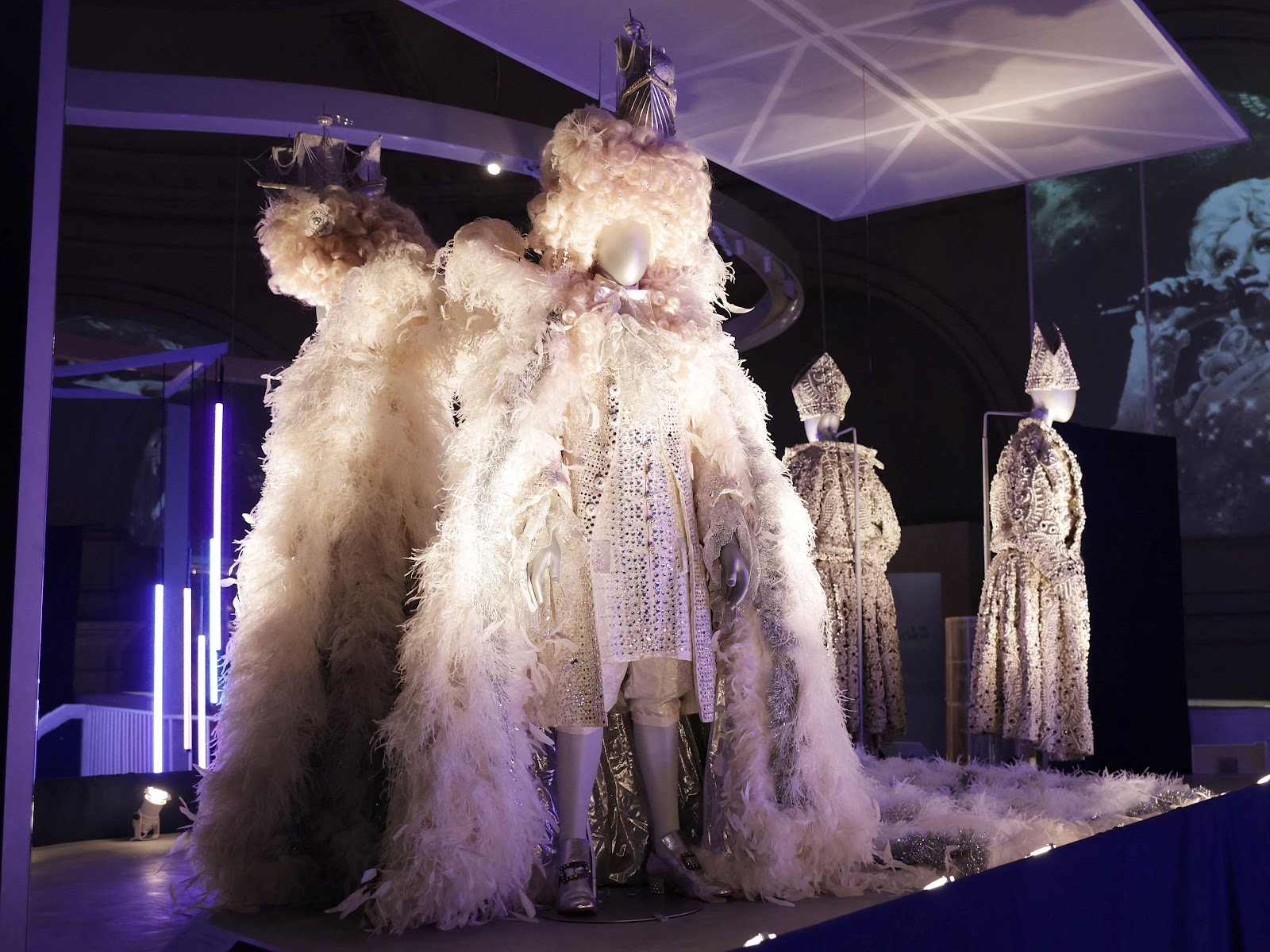
And from all this, we ascended the stairs - accompanied, appropriately, by the strains of You Don't Own Me - to be greeted by the dazzle-beyond-dazzle display of Rihanna's Met Gala creation, paired with Elton John's 50th birthday "Louis Quatorze" extravaganza, replete with massive wig adorned with sailing ship:

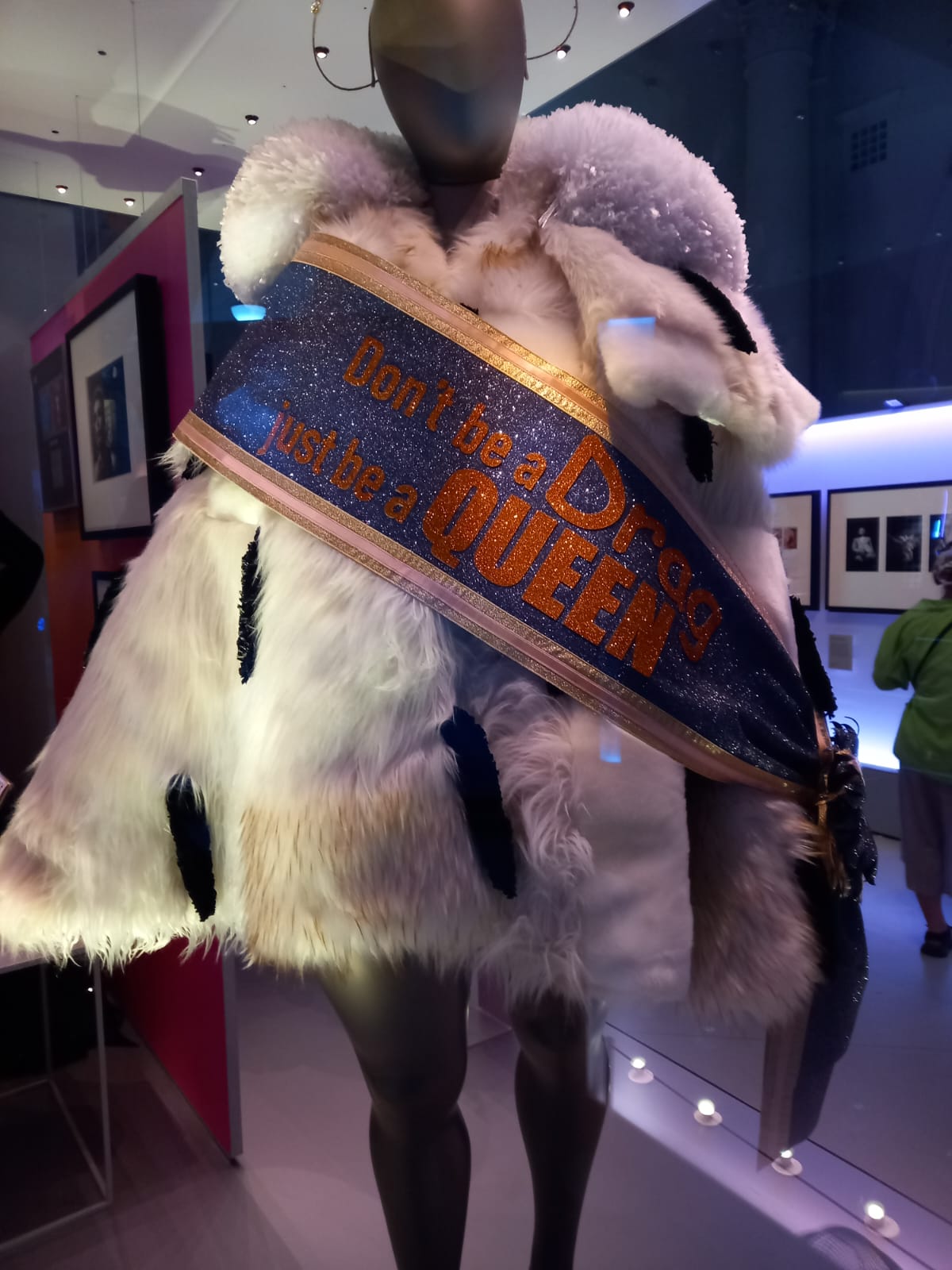
As if that weren't enough of a feast for the senses, the upper level of the exhibition is nothing short of a cornucopia of stars, each illustrating in their own way how they "Reclaimed the Diva" role. Just about everyone who is anyone is represented here - from Edith Piaf's teeny-tiny "little black dress" to Lizzo's not-so-tiny fake-fur wrap...

"To me, ‘diva’ is all about the power of the voice and the ability to entertain, to succeed against odds, to fight, and break through barrier after barrier: to have your voice heard.” - Dame Shirley Bassey

Of course, Dame Shirl's famous Glastonbury Festival ensemble is there, complete with diamanté-encrusted wellies, as is Liza Minnelli's lovely green number from New York, New York:

It takes hours to go around every display case, so much is crammed into that space. Madonna, Freddie Mercury, Beyoncé, Adele, RuPaul; all present and correct. Dusty Springfield, Kate Bush, Patti Smith, Missy Elliot, Mariah-fucking-Carey and Britney all get a nod [although we were surprised that neither Kylie nor Dame Joan Collins were anywhere to be seen]. Unlikely recipients of the "diva" label such as Debbie Harry, Siouxsie Sioux and Annie Lennox are here, too. It's not until one actually sees close-up artefacts such as Grace Jones' corset or Prince's shoes that you realise how small they actually are/were in real life!

A whole wall of cabinets and portraits is dedicated to those pioneering women who followed Josephine Baker's lead to use their fame and prominence to highlight societal injustice - Nina Simone, Ella Fitzgerald, Aretha Franklin, Janis Joplin and so on. There are stylish numbers, like Whitney Houston's from the 1994 Grammy Awards, Sade's super-cool outfit and a yellow one worn by Amy Winehouse, and then there are outrageously OTT costumes from the likes of Björk, Pink, GaGa, Lil Nas X and Janelle Monáe.

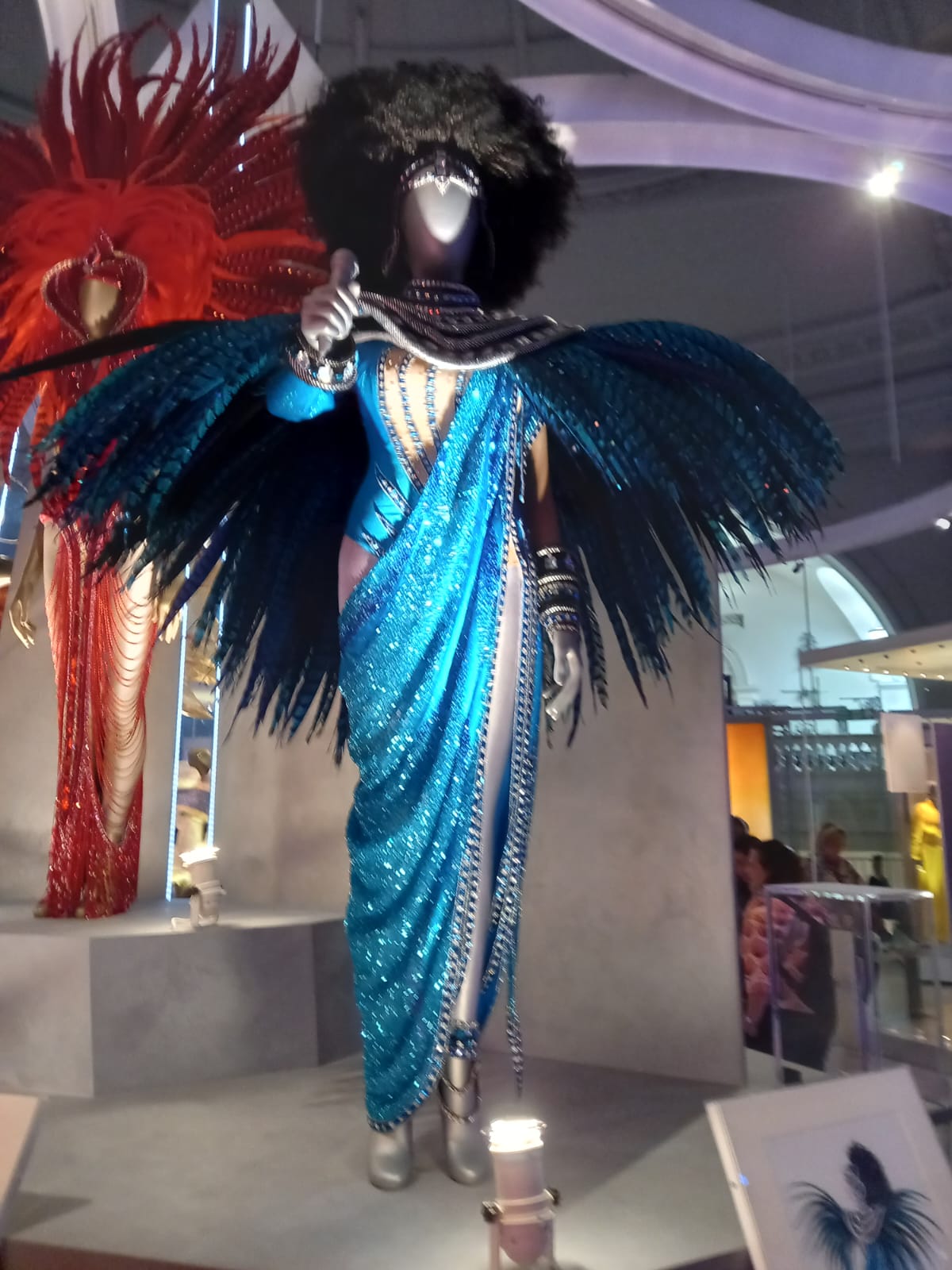
Taking centre stage, naturally, is the stunning display of Bob Mackie-designed extravagant costumes for Cher, Tina Turner and Diana Ross. Almost worth the price of entry by itself!

"You’re born naked, and the rest is Bob Mackie." - RuPaul

Utterly, totally, mind-boggingly fantabulosa!

I am definitely going to go again.

DIVA is on at the V&A until 7th April 2024.

[click any photo to enlarge]

Sunday, 11 June 2023

The Founding Father of the Italian Renaissance

Hils, Crog, "Beyonce" and I ventured out to the Victoria and Albert museum (the V&A) on Friday, to see the exhibition Donatello: Sculpting the Renaissance before it closed (today). It was every bit as awe-inspiring as one might expect - from the gigantic "Head of God", and an even bigger bronze horse's head, to the tiny dancing spiritello and (the faintly ridiculous) fresco "The Miracle of the Mule", everything was meticulous in its detail and, as the exhibition demonstrated, proved just how influential Donato di Niccolò di Betto Bardi was upon the explosion of artistic magnificence that was the Renaissance.

Here's the thoughts of Annabel Sampson in Tatler (who writes a review much better than I), to sum it all up:

That the ‘Founding Father of the Italian Renaissance’, darling of the all-powerful Medici family and subject of Giorgio Vasari has come to Blighty is a big deal. And it’s no simple feat given his work is spread out across altars, tombs and located up high in churches across Italy. This show marks the first time many of these works have ever, and possibly will ever, be on display in the UK – making it just that tiny bit more thrilling. Like early Renaissance Florence has landed on Cromwell Road.

While Donatello’s actual bronze David isn’t included in the exhibition it does have an uncanny painted plaster cast reproduction. ("I was at the Bargello in Florence last week and I can’t tell the difference," I overheard a neighbouring journalist whisper to their companion, which confirmed my thoughts.)

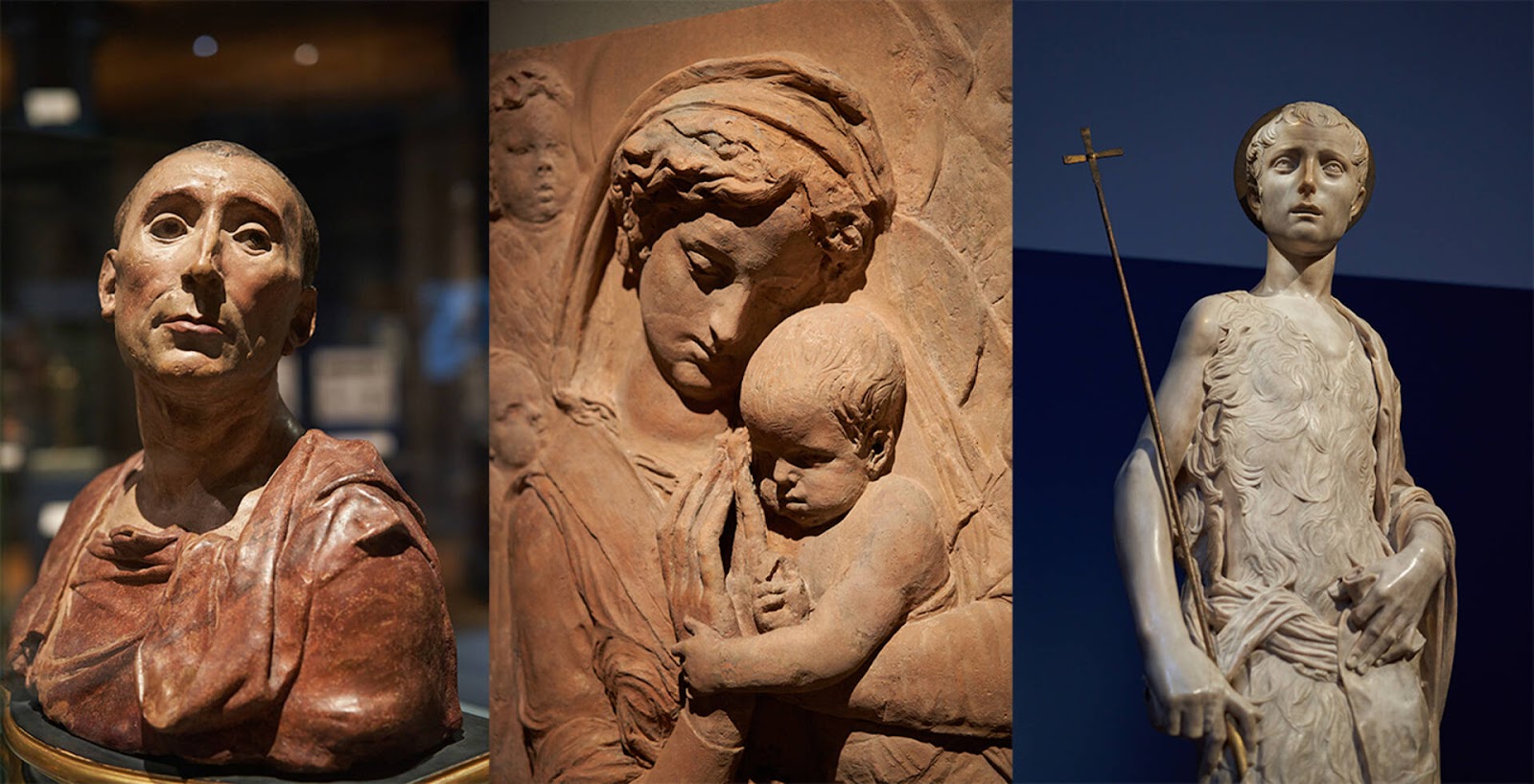
But the show, on the last leg of its three-country tour, does bring together some absolute show-stoppers. Namely, Donatello’s boyish, waif-like John the Baptist (so far from other depictions of the saint), his austere shimmering cast bronze bust of San Rossore and his poignant Madonnas. A whole wall is dedicated to the Virgin and Child, showcasing terracotta cheeks that look practically squeezable in their visceral plumpness. Then there’s an unmissable row of busts – which Donatello was instrumental in reviving.

And Donatello’s reliefs prove to be just that – a deep breath of a wholesome relief. Filled with jostling figures in carefully thought out compositions. Donatello is credited with inventing rilievo schiacciato (literally ‘squashed relief’) – a technique in which space and depth is created within just a few millimetres (brilliantly showcased in his Madonna of the Clouds). Donatello’s two older friends and colleagues, Filippo Brunelleschi and Lorenzo Ghiberti would also prove to be sculpting superheroes in the early Renaissance. Their influence is still felt today...

...Donatello [is] the star, but [his works are displayed] alongside works by his contemporaries and followers like Masacio, Luca Della Robbia and Michelozzo (to name a few) which aid the explanation of his influences and legacy.

Donatello has been far outlived by his legacy, as this exhibition proves, with countless followers drawing upon his ideas for their own designs. Classicism, certainly, will never go out of fashion: just look at the John Soane Museum, zeitgeisty interiors guru Luke Edward Hall (and his classical David-esque portraits) or the Grecian cherub planters on sale at Anthropologie. Carpe Diem, Ad Astra – thank you Donatello, long may we defer. This show is unmissable.

So very glad that we didn't miss it.

Even it it didn't feature the actual "best arse in sculpture":


[click any pic to enlarge]

Thursday, 25 February 2021

Are your outfits shameless, smart, quaint or ridiculous?


click to embiggen

The other day, over at my daily blog Give 'em the old Razzle Dazzle I posted a typically gaudy and OTT snippet from the (rare for a Dame Julie Andrews film) massive commercial flop Star! - the biography of the legendary Gertrude Lawrence - featuring the song The Physician.

On investigation I discovered that this number was originally from an otherwise forgotten West End musical in which Miss Lawrence starred, titled Nymph Errant - a bizarre comedy-of-errors about a girl returning to her finishing school, who went astray along the way and ended up in a Turkish harem. Unsurprisingly, The Physician is possibly the only thing associated with that production that was ever revived.

The musical was in turn based on a best selling novel of the same name by one James Laver - a fascinating character in his own right. An erudite and scholarly curator at the Victoria & Albert Museum (V&A), he had the good fortune to be appointed the first head of the institution's embryonic Theatre Collection - and developed a lifelong passion for costume and the study of fashion and its history. Somewhere along the way, he also became a central character in the "society party set" in 1920s and 30s London [whether that was because he ever wore, or allowed friends to wear, any costumes from the collection remains undocumented].

Scholarly or no, I just adore his simple analysis of "taste" and fashion trends and how attitudes towards them change with time - otherwise known as "Laver's Law":

Indecent 10 years before its time
Shameless 5 years before its time
Outré (Daring) 1 year before its time
Smart 'Current Fashion'
Dowdy 1 year after its time
Hideous 10 years after its time
Ridiculous 20 years after its time
Amusing 30 years after its time
Quaint 50 years after its time
Charming 70 years after its time
Romantic 100 years after its time
Beautiful 150 years after its time

Faboo!

And so true.

Sunday, 28 July 2019

J'Adore Dior


Hils, Al and I sashayed our way to the fabulous Victoria & Albert Museum (V&A) today for the latest blockbuster fashion exhibition - Christian Dior: Designer of Dreams.

Oh, my dears... the opulence! The style! The panache!

Will Gompertz, writing for the BBC agreed:
As you walk up to the imposing front door, your way is blocked by a black mannequin wearing the two-tone two-piece that defined both [his] inaugural 1947 show and Christian Dior.

The Bar Suit caused a sensation.

It was an extravagant, rebellious response to the grim austerity of post-war Europe. Instead of a dull boxy jacket and no-nonsense skirt that required minimal fabric or imagination to make, Dior presented a soft-shouldered, wasp-waisted silk jacket fanning out over the hips to reveal a long, dark blue pleated skirt, which took many metres of fabric to produce.

It was outrageously decadent in an era of rationing, but also fabulously exciting: a vision for the future that was colourful, opulent and beautiful... The fashionistas saw things differently. They absolutely loved what was immediately known as the New Look.

Christian Dior had arrived.

Why his work had such an immediate impact is obvious when you step over the threshold and into the first gallery. The designs he produced and the fabrics he used were the epitome of old-school glamour, with elegant lines - or silhouettes - cut from luxurious materials. They are a wonder to behold, at least on the outside.

I imagine the whalebone corsets and under-wired structures needed to retain the shape felt neither elegant nor luxurious. Still, Il faut souffrir pour être belle, as they say...

...There are galleries dedicated to historicism, the garden, the ateliers and, finally, a glitzy ballroom featuring animated glitter erupting across the ceiling and down the walls. The effect is only marginally compromised by non-slip rubber matting underfoot rather than a sprung wooden floor polished for dancing.

Christian Dior wasn't known for skimping on costs, and nor has the V&A.
With frocks designed by the great man himself, and by his successors Christian Dior, Marc Bohan, Gianfranco Ferré, John Galliano, Raf Simons and Maria Grazia Chiuri, hats by Stephen Jones, pieces worn by great style-setters of their day such as Margot Fonteyn, Princess Diana and Princess Margaret, and red-carpet numbers paraded by the likes of Jennifer Lawrence, Nicole Kidman, Lupita Nyong’o and Rihanna; everything from the most outlandish to the most timelessly classic and wearable designs in post-War couture history, all bound together with the history of the House of Dior and its founder, this was definitely one of the most impressive shows of its kind we have been to - and quite rightly it has sold out for most of its (recently extended) run.

Christian Dior: Designer of Dreams [if you can get a ticket] is on at the V&A until until Sunday 1st September 2019.