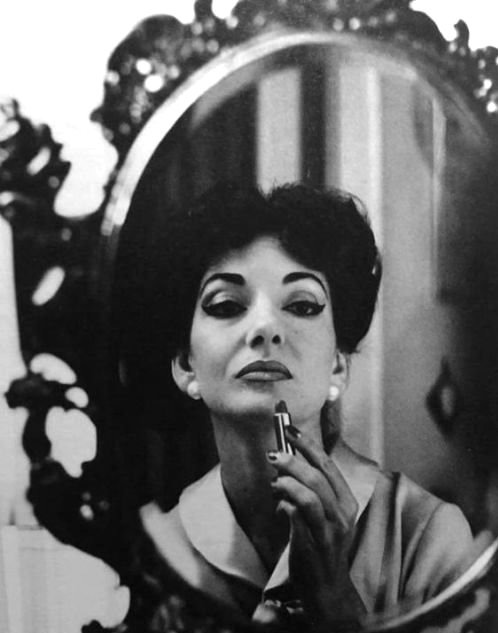
Showing posts with label Maria Callas. Show all posts

Saturday, 2 December 2023

There is only one way, one voice. Yours.

"An opera begins long before the curtain goes up and ends long after it has come down. It starts in my imagination, it becomes my life, and it stays part of my life long after I've left the opera house."

"Art is domination. It's making people think that for that precise moment in time there is only one way, one voice. Yours."

"I don't know what happens to me on stage. Something else seems to take over."

"I don't need the money, dear. I work for art."

"I am not an angel and do not pretend to be. That is not one of my roles. But I am not the devil either. I am a woman and a serious artist, and I would like so to be judged."

"You are born an artist or you are not. And you stay an artist, dear, even if your voice is less of a fireworks. The artist is always there."

"When my enemies stop hissing, I shall know I'm slipping."

One hundred years ago, the Diva to beat all Divas was born.

All hail!

Maria Callas (2nd December 1923 – 16th September 1977)

Monday, 7 December 2020

Fan Club


Mary Martin (1st December 1913 – 3rd November 1990)


Maria Callas (2nd December 1923 – 16th September 1977)


Agnes Moorehead (6th December 1900 – 30th April 1974)


Zeki Müren (6th December 1931 – 24th September 1996)


Concha Piquer (8th December 1908 – 12th December 1990)


Elisabeth Schwarzkopf (9th December 1915 – 3rd August 2006)

"Fan for me fan for me, fan!"

Wednesday, 21 February 2018

Not a sing-a-long


Venetian courtesan, complete with towering platform shoes

An extravaganza of a show, much publicised and universally lauded by the critics, the Victoria and Albert Museum (V&A) really went to town on its most recent blockbuster exhibition Opera: Passion, Power and Politics, which Hils, History Boy and I went to see last weekend (its last but one before closing). [A busy day all round - Hils and I also caught the final showing of a show I blogged about before: Balenciaga: Shaping Fashion, which was definitely worth catching.]

This was a bit of a "curate's egg", if truth be told. The exhibits were as over-the-top and brilliant as one might expect from the V&A, with an eclectic mix of priceless rarities (unique instruments; hand-scribed manuscripts; original art masterpieces) and more obvious items (busts of the great composers; costumes and scenery) on show.


Baroque opera costume

It was only let down by the bizarrely random technology of the audio headsets - these were meant to play commentary and music to set each scene, but clashed horribly with the over-loud music actually playing through the speakers in the exhibition and, if one moved even slightly away from the appropriate "hot-spot", one piece of delightful music faded away into another and back again...

Nonetheless, in extracts from this review by Jan Dalley in the Financial Times the rest of the experience is summed up better than ever I could:
"Death! Lust! Ambition! Decadence!" screams the wall text for Monteverdi’s L’incoronazione di Poppea, the first of seven operas under the spotlight... In terms of subject matter at least, this is opera starting as it means to continue.

Although opera has its roots in popular forms - pantomime, circus, carnival and street entertainments - it was in Venice in 1643, with Poppea, that the private musical entertainments of the super-wealthy rose to such a pitch of sophistication that they burst more or less fully formed on to the public stage, a new genre.

So opera was born a sophisticated form, demanding and revelling in the heights of musical technique and lavish presentation. It is the art form that encompasses all the others, not just music, singing, dance, acting and narrative but also design, stage architecture and more. Its storylines, as the wall texts in this brilliantly presented show emphasise, have always been intense: fantasy and myth, wars and dark deeds, love and rage, the heights and depths of human emotion. And, increasingly, social and political comment and satire.

Bernardo Strozzi - The Viola da Gamba Player
The exhibition shows this all-encompassing artistic environment, with paintings - superb thematic loans include Manet, Degas and many more - costumes, a reconstructed baroque stage, maps and posters, instruments, letters and so on. But it is interested chiefly in the social and political milieux that gave birth to these operas, each in a different city, usually at the moment of its rise to prosperity: through this lens, it’s a history of Europe itself.

Yes, opera has always followed the money. From Venice we walk on through the show’s loosely constructed maze, made of rough structures that suggest the backstage reality supporting the onstage glitz, to rich mercantile London, and the opening of Handel’s Rinaldo in 1711. It is a daft love/war story, but it had potential for the spectacular baroque stage effects that fashion demanded: a ship tosses on the waves of the tiny, elaborate theatre set as we listen to the mermaids calling.

In Vienna, just as the excesses of the licentious 18th century were about to meet a new radicalism, opera found its rebellious streak. Mozart and his librettist Da Ponte had to tone down the full political clout of Beaumarchais’ original to make their comedy of class and manners in Le Nozze di Figaro, the first opera to give prominent roles to servants. But the writing (“Lust! Egalitarianism! Mischief!”) was, and is, on the wall.

Mozart's harpsichord
Verdi’s Nabucco, in the Milan of 1842, gives us the voice of Maria Callas as Abigaille, in a rare (for this show) display of one of the great divas: they are not part of the story as it is told here. And with the giant chorus of the Hebrew slaves, Va, pensiero, culture is in full battle mode, embroiled in Italy’s nationalist struggles; the huge swell of voices in the chorus that became an alternative national anthem for the new Italy is interspersed with gunfire.

Giuseppe Verdi


Eva Gonzalès - Une loge aux Italiens [A Box at the Theatre des Italiens]
Radicalism, both musical and otherwise, haunted Wagner’s Tannhäuser (“Personal struggle! Morality!”), shown here not at its 1845 Dresden premiere but at its disastrous outing in Paris in 1861, where the composer’s rebellion against the conventions of Grand Opera, which demanded a lengthy ballet, led him to insert in the Venusberg music one of opera’s sexiest scenes. A rank of TV screens shows us a montage of recent productions: quite raunchy, even for today. At the time there was shock, horror and - since the opera had come to Paris at the behest of Napoleon III - anti-Bonapartist anger. Wagner, lampooned in a magazine as a tiny figure inside a giant ear, attacking the eardrum with a hammer and chisel, took the opera off after three nights.

There is more sex to come. Richard Strauss’s Salome, which premiered in wealthy, liberal Dresden in 1905, appears here in a video of David McVicar’s recent production with Salome, crawling half-naked, half-crazed and soaked in gore, passionately kissing the severed head, while the fierce nudes of Kirchner look on from the opposite wall. In front of the screen stands Freud’s carpet-draped couch: just a few years on from Breuer and Freud’s studies of hysteria, the opera was a potent mash-up of new thinking - psychoanalysis, gender and the power of sexuality - allied to one of mythology’s most powerful tales of greed and eroticism untamed. The composer’s copy of Oscar Wilde’s Salome, with its Beardsley illustrations, is a revealing extra.

From the unbridled Salome to the sturdy feminist figure on a 1925 International Women’s Day poster is a substantial jump in depictions of women. Now Shostakovich’s ill-fated Lady Macbeth of Mtsensk (“Murder! Passion! Bourgeois housewife!”) shows that in 1934 the ancient themes of love, jealousy and revenge still flourished in the new Soviet reality - although Stalin didn’t like to think so. The opera was censored; Shostakovich never wrote another.

The final room, with its large screens and performance stage, shows through a range of newer operas, including George Benjamin’s brilliant Written on Skin, why - if after this inspiring exhibition you are in any doubt - such a bizarre, apparently arcane art form still flourishes.
Bizarre and "arcane" it may be, but one can only gasp in wonder sometimes when one hears a sublime performance such as this...

Monday, 2 December 2013

I am not an angel and do not pretend to be


"An opera begins long before the curtain goes up and ends long after it has come down. It starts in my imagination, it becomes my life, and it stays part of my life long after I've left the opera house."

"I don't know what happens to me on stage. Something else seems to take over."

"I don't need the money, dear. I work for art."

"I am not an angel and do not pretend to be. That is not one of my roles. But I am not the devil either. I am a woman and a serious artist, and I would like so to be judged."

"When my enemies stop hissing, I shall know I'm slipping."


Maria Callas (2nd December 1923 – 16th September 1977)

Callas sings over at Give 'em the Old Razzle Dazzle.

Thursday, 25 April 2013

Life is a party


"Only an expert fabricator could survive the public tightrope walk required of someone trying to portray herself as both the taste-making doyenne of European society and a self-effacing American nobody." - biographer Sam Staggs
If you weren't invited to an Elsa Maxwell party in the mid-20th century celebrity whorl, you were nobody. She knew something about everyone.

Elsa Maxwell injected a sense of fun into post-war society parties, and the great and the good came flocking to her door to lap it up, from royalty to Hollywood. The superstars of the entertainment world all carefully kept the grande dame on side, for fear she would launch a tirade against them in one of her syndicated newspaper gossip columns or numerous TV appearances.

She not only entertained in person and in print, she also wrote books on "etiquette", wrote and produced music for theatre and film (and appeared in a few) - and in 1959 she even recorded an album of her own, Elsa Maxwell - Her Voice and Music [oh, if only I had a copy of that!].

A bizarre mix of contradictions, Miss Maxwell was renowned for being coarse and vulgar yet aspired to mix with the highest echelons, and she was probably a lesbian (and quite possibly a stalker at that) yet publicly decried homosexuality. Certainly, by all accounts she was a much-feared harridan.

Her endless name-dropping and not-so-subtle snobbery belied the fact that she was (in her own words) "a short, fat, homely piano player from Keokuk, Iowa, with no money or background, who decided to become a legend and did just that."

Yet when she died, aged 82 in 1963, barely a dozen people turned up for her funeral. The party probably wasn't big enough, or fun enough. Or maybe the joke had simply run its course.

"Life is a party. You join after its started and you leave before its finished."

"I don't hate anyone. I dislike. But my dislike is the equivalent of anyone else's hate."

"Nothing spoils a good party like a genius."

"Laugh at yourself first, before anyone else can."


Elsa Maxwell (24th May 1883 – 1st November 1963)